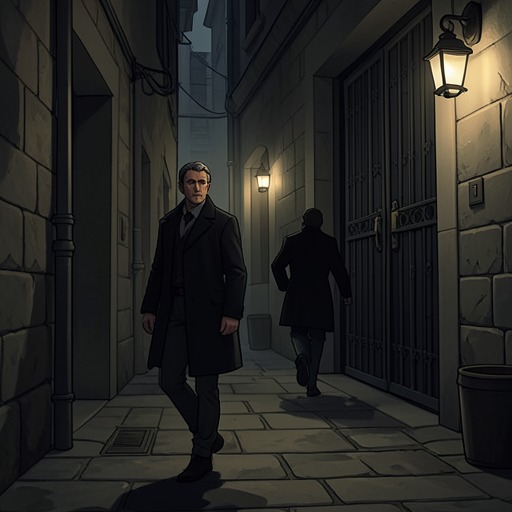
Allen
New Life as a Max Level ArchmageAllen is a local temple acolyte in Prismarche and a minor but revealing figure in the city’s Peace Day crisis. His role begins in apparent simplicity: he is a cheerful young man associated with the temple and the Adventurer’s Guild, eager to discuss magic and inclined toward reassuring, faux-wise observations. Yet the ambush that captures him with Saffra, followed by his practical assistance in the guardhouse, shows that his importance lies less in combat than in the contrast between youthful innocence, institutional familiarity, and genuine responsibility.
Identity and Introduction
Allen belongs to Prismarche’s temple community and is sufficiently familiar to the Adventurer’s Guild that Saffra recognizes his face after spending four months sleeping there. He is described as a local acolyte who often visits the Guild, making him part of the city’s ordinary religious and adventuring life rather than an outsider swept in for the festival. He is also a member of Lailah’s temporary expedition party, traveling with Lailah, Dominic, a young man in white robes, and Saffra beyond the city walls into the pine forest.
His first impression is deliberately mixed. Allen is about half a decade older than Saffra, but she considers him immature and repeatedly frames him as a cheerful idiot who does not understand the danger surrounding him. He talks at length about a healing spell he has recently mastered while the party treks behind Lailah and Dominic. To Saffra, this behavior suggests an alarming inability to read the situation; to the reader, it establishes the gap between Allen’s optimistic manner and Saffra’s suspicion.
The Expedition and Capture
Allen joins the wilderness party during Prismarche’s centennial Peace Day celebration, when the city contains roughly three times its usual number of adventurers and an influx of unfamiliar travelers is entirely plausible. That crowded, festive setting gives Lailah and Dominic cover. Saffra cannot prove that they are dangerous, and their reasons for visiting Prismarche appear natural because the city is the nearest border settlement to the seventh Cataclysm Monarch’s domain and the final destination associated with the Party of Heroes.
Saffra nevertheless feels compelled to watch over Allen. She does not know him well, but his local connection to the temple and Guild gives him a familiar place in the city she has begun to treat as home. Her decision to remain with Lailah’s party is therefore not based on friendship or prior loyalty. She cannot let the cheerful acolyte face the danger alone, even while insisting to herself that she should be looking after her own survival.
The threat becomes explicit when Lailah secures a cold, rune-engraved suppression artifact around Saffra’s neck. The device greedily drains away the mana she tries to summon, cutting off her magic. Dominic then forces her to the ground and binds her. Allen, confused and still unable to understand what is happening, is thrown beside her, bound and gagged. Their shared capture changes the expedition from an awkward social outing into a carefully prepared abduction, and Allen’s helpless glance toward Saffra intensifies her guilt because she believes that she has led him into the trap.
Conduct Under Pressure
Allen’s capture exposes the limits of his apparent confidence. He is not presented as someone capable of breaking the suppression artifact or defeating Lailah and Dominic; instead, he becomes a powerless witness to Saffra’s terror. The fact that the kidnappers take both captives alive makes the situation more frightening, since their purpose is evidently more deliberate than simple robbery. Allen’s shock, frantic looking around, and enforced silence place him among the people endangered by the conspirators rather than among those who understand the larger plot.
His conduct after the rescue gives him a more substantial character dimension. Vivi defeats Lailah and Dominic and keeps their bodies suspended before her staff with Greater Telekinesis, then asks whether Allen and Saffra have been hurt and proposes returning to the city to hand the prisoners over to the guard. Allen checks himself and then looks toward Saffra, while Saffra avoids his gaze and silently indicates that she is unharmed. The exchange is brief, but it places Allen within the scene’s moral center: he is not merely evidence of the criminals’ wrongdoing, but one of the people Vivi is trying to protect.
Practical Competence and Relationships
Allen’s relationship with Saffra begins without intimacy. She barely knows him, regards him as foolish, and initially resents having to account for his safety. Nevertheless, her suspicion of Lailah and Dominic develops into protective concern for him, while his presence makes the danger personal rather than abstract. Their captivity binds them through shared vulnerability, even though Saffra interprets the event primarily as her own failure to protect him.
Allen’s relationship with Vivi is likewise formed through crisis. Vivi rescues him rather than meeting him under ordinary temple or Guild circumstances, and she notices that he has endured the attack without being seriously injured. He does not become a combat partner, but his local knowledge proves more useful once they return to Prismarche. When the gate guards, guardhouse officials, and other authorities repeatedly demand explanations for Vivi’s prisoners, her irritation begins to show. Allen takes over the procedural details despite being her junior, because he understands the city’s system better than she does.
That intervention is the clearest reversal in his characterization. The person Saffra has dismissed as a foolish, overconfident acolyte becomes the one best equipped to manage the aftermath. His competence is administrative rather than spectacular, but it is exactly what the situation requires: Vivi can capture the criminals, while Allen can help translate that extraordinary intervention into the ordinary processes of Prismarche’s guard system.
Narrative Function and Significance
Allen’s presence anchors the crisis in the city’s everyday institutions. The temple, the Guild, the guardhouse, and the Peace Day crowds are not merely scenery; they are the social structures through which danger is concealed, recognized, and eventually processed. As a temple acolyte who frequents the Guild, Allen connects those structures. His local status also explains why his knowledge matters after the rescue, when Vivi’s extraordinary power and unknown identity attract more attention than the case itself.
He functions as a counterpoint to Saffra. She is suspicious, defensive, and alert to hidden motives, while Allen is open, talkative, and inclined to interpret circumstances generously. Her instincts prove correct about Lailah and Dominic, but her judgment of Allen is only partly accurate. He is naïve enough to be endangered, yet capable enough to help resolve the bureaucratic consequences. The narrative therefore uses him to distinguish innocence from uselessness: Allen may fail to recognize the trap, but he is not incapable of meaningful action once the danger has passed.
Allen also helps reveal the difference between the festival’s public atmosphere and its underlying reality. Prismarche is celebrating a century since the Party of Heroes defeated the seventh and final Cataclysm, a victory achieved at the cost of nearly every member of the Party except the Sorceress. In that city of heroic monuments, temples, stained glass, and mass celebration, Allen represents the ordinary human continuity that such history is supposed to protect. His abduction demonstrates that the old violence has not vanished simply because the population commemorates its end.
His ending in the supplied episode is not a dramatic transformation or a heroic elevation. He survives the capture, remains physically present when Vivi returns the criminals to the authorities, and quietly assumes the practical work that his rescuer cannot or will not handle. That modest resolution is precisely his narrative value. Allen’s contribution is measured not by legendary power but by familiarity with the systems of communal life, making him a small-scale embodiment of the world’s ability to respond to extraordinary violence through ordinary responsibility.